
Additional Learning Support
The Additional Learning Support (ALS) Team is made up of the following staff:
- Anna-Lisa Ghale, Head of ALS (qualified SENDCo)
- Four Specialist Teachers
- A small team of Learning Support Assistants
- Exams Access Arrangements Co-ordinator
- Safeguarding and ALS Administrator
We are a friendly team with a wealth of knowledge and experience of all types of special or additional needs and are passionate about supporting young people to fulfil their potential.
Campus Accessibility
The site is accessible with disabled toilets, ramps, lifts and automatically opening outer doors. Inner doors are not automatic opening, but students with mobility needs will be supported as required to ensure they can access all student areas of the site.
Classrooms and classes can vary in size depending on the subject studied. Staff use their best endeavours to organise supportive seating plans based on everyone’s needs.
The Additional Learning Support Department
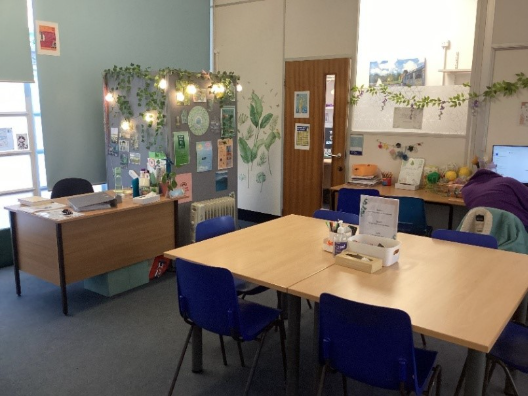
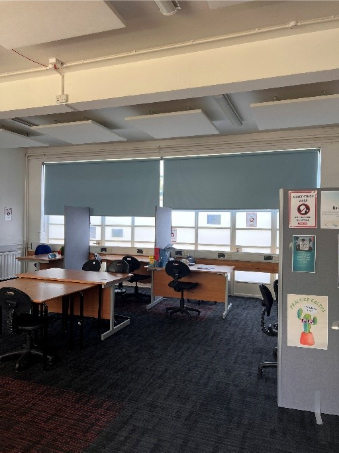
We have 2 quieter supervised spaces within the ALS department: C12, our low sensory room, and C13, our silent study room. Students can come to these areas to find support if needed. We also have a further room, C14, which is primarily reserved for students with EHCPs to use.
The ALS team run a small number of lunch time clubs each week such as Connect Art and Crafts Club. Clubs are open to all and are a great way to meet other people and gather as friends.
Admissions Criteria for Students with EHCPs (Education, Health and Care Plans)
All students, regardless of an EHCP, must qualify for the course they wish to study. Instructions on how to apply to Long Road can be found on the Join Our College section of our website.
We strongly advise that students visit Long Road Sixth Form College during our Summer Term Open Evenings, or book to attend one of our Autumn Term tours. Please be aware we can only offer a very limited number of tours, and spaces book up extremely quickly. We strongly recommend attending an Open Evening wherever possible to see our facilities and meet the ALS staff.
At the Year 11 annual review of the student’s EHCP, a request can be made to their Local Authority to explore a placement at Long Road Sixth Form College. The Local Authority will consult the college about a placement. If the student qualifies for the courses they wish to study, and the college believes it can meet the special educational needs and provision, and the student has completed an application to the college, then they will be offered an Advice and Guidance meeting in the Spring Term and a conditional placement based on predicted GCSE grades may be made.
Transitioning from secondary school to Long Road Sixth Form College
We recognise that the transition from secondary school to a large sixth form college can be daunting. The step up from GCSEs to level 3 study is considerable. Some students are offered one transition afternoon in the summer term, in addition to the college Welcome Days.
To ensure we have up-to-date information about everyone’s support needs, we liaise with secondary schools and other educational providers to produce a Transition One Page Profile which summarises support strategies. Staff refer to these at the start of term to ensure that students’ needs are met in lessons.
We recommend that students who hold offers of a place to study at Long Road Sixth Form College undertake preparation activities after they have completed their GCSE exams. All students will be required to complete subject Summer Work set by the course leader.
Recommended activities to get ready for sixth form college:
- Learn to touch type Learn Touch Typing Free - TypingClub
- Practise your journey to college
- Practise buying travel tickets and using travel apps, e.g. Stagecoach bus app
- Think about “What if….?” plans for scenarios you may face, e.g. the bus is delayed, or the train is cancelled.
- Practise going into busy environments
- Practise going to a café and ordering your drink/food
- Buy a planner / diary ready to record your tasks, or start using an online calendar.
- Research and trial study and support apps that could help with organisation and learning, e.g. Goblin tools, Tiimo, Todoist, Otter.ai, Speechify.
- Plan strategies to help you manage at college (what workarounds will you put in place?) e.g. learning and practising some emotional regulation strategies
- Read up on The A Level Mindset and VESPA – you will be using this framework at college
Support for Students with Medical Needs
At Long Road Sixth Form College, we are committed to supporting students to participate fully in college life while developing the independence and self-management skills needed for adulthood, further study and employment.
As a post-16 provider, our expectation is that students will in most cases be able to manage their own day-to-day medical needs while attending college. Students are responsible for carrying and administering their own prescribed medication, including inhalers, preventative asthma medication, adrenaline auto-injectors (such as EpiPens® or Jext® devices), and any other medication required to manage their condition.
Medication in College
- Students should keep their prescribed medication with them at all times where it may be needed in an emergency.
- The College does not routinely store student medication, unless there is a specific requirement for refrigeration or in order to control its use.
- The College does not hold spare adrenaline auto-injectors (EpiPens®, Jext® devices or similar) for student use.
- Students are responsible for ensuring that any prescribed emergency medication is in date, available when required, and carried with them.
Individual Healthcare Plans
Where a student has a significant medical condition that requires assistance from College First Aid staff during the college day, the College will require an Individual Healthcare Plan (IHCP) to be agreed and put in place.
Examples may include, but are not limited to:
- Epilepsy
- Diabetes
- Serious cardiac conditions
- Severe allergies requiring emergency medication
- Unexplained seizures or seizure-like episodes
- Other conditions that may result in a medical emergency or require a specific response from staff
The Individual Healthcare Plan should be completed in partnership with an appropriate healthcare professional and provide clear guidance on:
- The student's condition
- Medication requirements
- Signs and symptoms that indicate cause for concern
- Actions and procedures to be followed
- When emergency services should be contacted
- Any reasonable adjustments required within the college environment
This information enables our First Aid team to respond appropriately and safely should a medical incident occur while a student is attending college.
Working in Partnership
Students and parents/carers should inform the College of any significant medical condition before enrolment or as soon as possible following diagnosis. The College will work with students, families and healthcare professionals, where appropriate, to ensure relevant information is shared with staff who may need to know and with any attending healthcare professionals.
Our approach is designed to support both student wellbeing and the development of the independence and self-management skills that are an important part of preparation for adulthood.
Important Information
This information outlines Long Road Sixth Form College's current arrangements for supporting students with medical needs and promoting independent self-management. It is not intended to constitute a formal medical needs policy and should not be regarded as legal or medical advice.
The College's arrangements are subject to ongoing review in line with safeguarding responsibilities, health and safety requirements, guidance from the Department for Education, and any future statutory requirements applicable to further education providers. Long Road Sixth Form College reserves the right to amend its procedures and requirements as legislation, guidance, or best practice develops.
Where a student's medical condition presents a significant risk to their health, safety or ability to access classroom education at Long Road, the College may require additional information from healthcare professionals and may implement individual arrangements to support the student's participation in college life.
Support for EHCP and Additional Needs
Universally Available Provision
The following provision is available to all students at college:
- Study / Subject Plus Time on Tuesday and Wednesday at 2.40pm
- Progress Coach Termly meetings
- Bookable wellbeing support
- Bookable LSA study support session
- Request Appointment with Specialist Teacher
- ALS lunch time clubs
- “Need Support” Student self-help Microsoft Teams channel
Targeted Support
The following provision is provided as targeted support:
- Co-production of One Page Profile
- Regular attendance at Study / Subject Plus Time
- 6-week LSA study skills support
- 6-week Specialist Teacher Support
- Allocated workspace in C13 study room
- Access to low sensory room C12
- College laptop loan
- Agreement on colour of coloured overlay (to be provided by the student)
Specialist Support (EHCP)
- Weekly meetings with Specialist Teacher
- Regular LSA study support sessions
- Access to C14 workspace
- Age-appropriate Interventions as specified in Section F of EHCP
What do Specialist Teachers do?
Specialist Teachers are qualified teachers who have additional qualifications in SEND. They act as key workers to students with EHCPs and meet them weekly to unpick any difficulties, solve problems, set targets, and deliver SEN provision set out in the student’s EHCP.
Our Specialist Teachers are also Access Arrangements Assessors and complete exam access arrangements assessments with students.
Specialist Teachers meet with students who have new diagnoses, medical needs and those who need a higher level of support. They work short term with students to help identify needs, and co-produce support strategies which are then shared with staff.
The ALS, Guidance and Careers teams work very closely together to support students at college.
Identifying new SEND / Additional Needs
Assess, Plan, Do, Review Cycle
Students who are identified by any staff member as needing additional support due to significant difficulties with learning and progression are referred to the ALS Department. Usually, a meeting is held with the student, their parents/carers and the referring member of staff to identify barriers to learning and supportive ways forwards. The discussion will be recorded on an Assess, Plan, Do, Review (APDR) document which is then shared with all parties and forms an outline of needs and support to be put in place. All interventions are evaluated for impact, and progress will be reviewed at a follow-up meeting. A student can go on to have several cycles of APDR until the issues are resolved. If three or more cycles of APDR indicate more severe needs or a student requires more resources to support their needs, we may look to apply for an EHC needs assessment with the student’s home Local Authority. APDR cycles may also be part of a Fitness to Study Plan.
Special Educational Needs Register
As a college, we do not keep a formal SEND Register in the same way as a school. However, we do keep a register of reported needs to ensure that we identify the diversity of students. Any student who feels they need support can self-refer to the ALS Department via a QR code.
Applying for an EHCP
Once a student is 16 years old, they can apply for an assessment of their special educational needs through their Local Authority. Usually this is done in conjunction with ALS staff, but students can also complete the application themselves.
- Click here to visit the Cambridgeshire County Council EHCP webpage.
- Click here to visit the Hertfordshire County Council EHCP webpage.
EHCPs can remain in place for a student up to level 3 study. Once a student has completed Level 3 study their EHCP will cease. For further information, please visit: (IPSEA) Independent Provider of Special Education Advice - Can I have an EHC plan after I finish college?
Referral for ADHD and Autism Assessments
Due to long NHS waiting lists for Autism and ADHD assessments, we advise that students research the best options for them. Information about the pathways is available below.
- Click here for the Cambridgeshire and Peterborough NHS under 18s referral pathway.
- Click here for the Cambridgeshire and Peterborough NHS adult ADHD referral pathway.
- Click here for the Cambridgeshire County Council Early Help assessment process.
Whilst a diagnosis can provide validation and open doors to support, it does not provide the support needed at college. We advise that students with a new diagnosis request a meeting with a Specialist Teacher to co-produce a One Page Profile which outlies difficulties and barriers to learning and advises staff on support strategies to use in lessons.
Exam Access Arrangements
Any access arrangements must be agreed well in advance of any public examinations and will reflect the student’s normal way of working.
The college follows the JCQ Access Arrangements and Reasonable Adjustments regulations (updated annually).
The college access arrangements policy is available on our website, please click here to view.
If a student had Exam Access Arrangements at GCSE level /secondary school:
Cambridgeshire Area Partnership (CAP) Secondary schools usually share the student’s Form 8 or 9. However, it’s the student’s responsibility to ensure we have received it. Schools who are not members of CAP do not share this information, and we advise that students contact their school to ask for their Form 8/9 to be sent to our Exams Access Arrangements Coordinator through support@longroad.ac.uk.
If a student has exam access arrangements for Level 2 / GCSE study, this does not guarantee that they will qualify for exam access arrangements at Level 3 study. A student’s normal way of working, information from teachers, samples of timed tests and the student’s Form 8 / 9 will be used to determine whether the student qualifies for exam access arrangements.
If a student is considered for new Exam Access Arrangements Assessments
If a teacher believes that a student has a substantial, long-term and persistent learning difficulty or medical condition, they can refer them to the ALS team for access arrangements investigation.
Each subject teacher must submit their observations regarding a student’s normal way of working and subject test evidence to the Access Arrangements Co-ordinator. Once received and reviewed, the student may be offered an appointment for a computer-based screening. Following evaluation of the results, a face-to-face appointment may be made with a Specialist Teacher for further testing. The student’s needs and any agreed access arrangements are recorded on their One Page Profile along with in-class support recommendations.
Access arrangements are only formalised and confirmed once an application has been made to the exam boards through the Joint Council for Qualifications (JCQ). The student’s Statement of Entry for public exams will list the exam access arrangements that have been agreed. Changes to exam access arrangements cannot be made once the final Statement of Entry has been sent out.
If a student has medical needs and requests exam access arrangements / reasonable adjustments for exams, we will request up-to-date medical or diagnostic letters from clinicians, usually at consultant level. External professionals may recommend or support exam access arrangements for a student, but the decision to award them lies with the centre. Medical evidence helps to form a picture of need.
If a student does not use any of their awarded access arrangements, then the arrangement will be withdrawn.
For more guidance on access arrangements please click here, or view the documents below.
Useful Links
Local Offers
- Cambridgeshire SEND Information
- East Cambridgeshire Local Offer
- Hertfordshire SEND Local Offer
- Essex SEND Local Offer
- Suffolk SEND Local Offer
- Norfolk SEND Local Offer
- Bedfordshire SEND Local Offer
- Peterborough Local Offer
Dyslexia / Dyspraxia / Dysgraphia / Dyscalculia
- British Dyslexia Association
- Dyslexia Action
- Dyslexia UK
- Dyspraxia Ireland
- International Dyslexia Association - Understanding Dysgraphia
- National Numeracy - What is Dyscalculia?
Developmental Language Disorder
ADHD
- NHS Cambridgeshire Community Paediatrics - ADHD
- ADHD Foundation Neurodiversity Charity
- ADHD UK
- ADHDadultUK
- ADDitude
Autism
- National Autistic Society
- Spectrum
- Autism Anglia
- Autism and sensory processing
- Ambitious Youth Network | Join the Ambitious Youth Network
- Autism Charity | Ambitious about Autism
Sensory Integration
Organisation and Planning (Executive Functioning)
Support for Families
Support for Employment